

I do call myself an audiophile. And I do hunt for the best quality lossless audio sources for my favourite albums. But I don’t spend fortunes on audio equipment. Knowing the basic physics, and how analog and digital audio works (both as a music producer and a listener), and having some time spent listening to some really cool high-end systems and really trashy low-end counterparts, I believe I can shed some light on the audiophile culture, analog versus digital debate, wired versus wireless debate, and the experience of high-fidelity music.
I am penning this now, especially now, because the audio world is completely infested with marketing snake oil, pseudo-science, and gatekeeping elitists. Beneath all these pretentious nonsense, there is actual, hard physics that not a lot of folks know about. So, in this geekswipe edition, I’m going to rip away the marketing fluff and explain to you what actually makes audio sound good.
What is digital audio anyway?
At a very fundamental level, sound is just a continuous wave of air pressure hitting your eardrums. It’s a simple pressure wave.
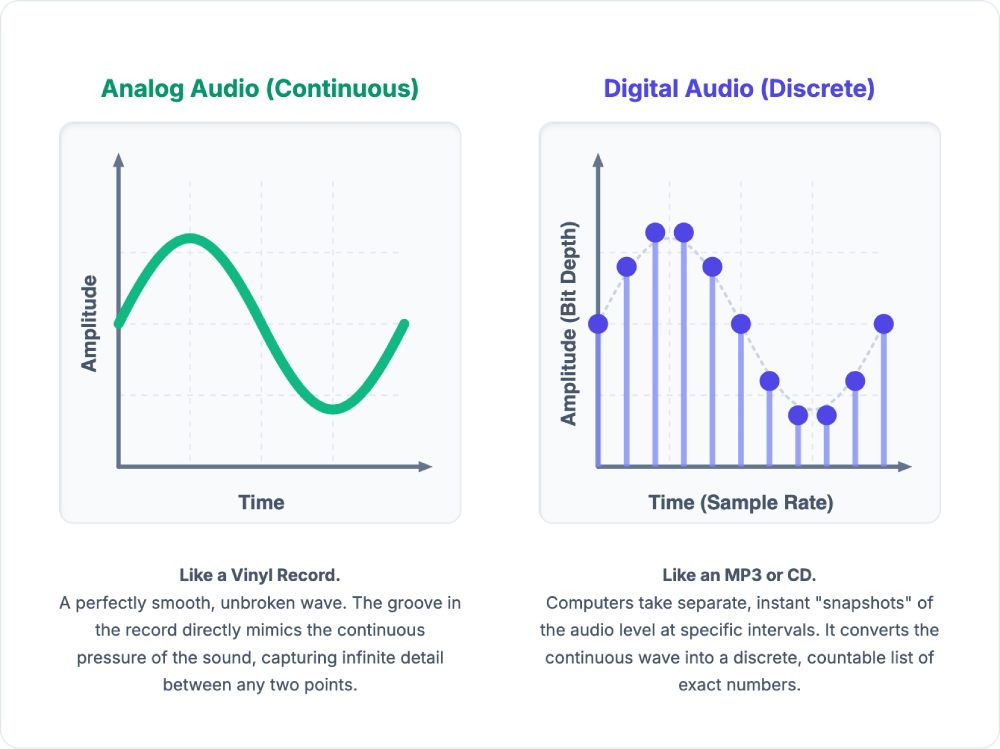
Analog audio (like vinyl or cassette tape) tries to record that continuous wave physically, capturing all the points in the wave.
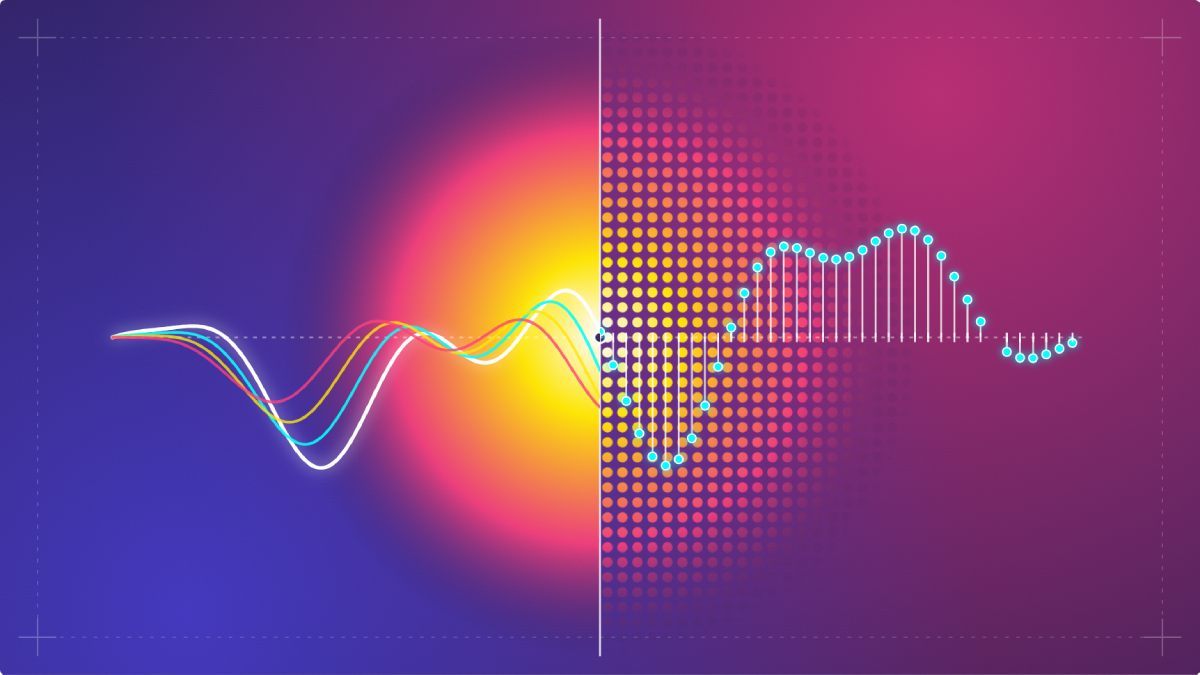
A digital recording, however, doesn’t record a continuous wave. It takes rapid photographs of the waves and stitches them together. It’s a recording of discrete states (I will explain this. Read along). To understand digital audio, you only need to understand two things. Sample Rate and Bit Depth.
Sample rate
Imagine you are trying to draw a curved line on a piece of graph paper.
Sample Rate is how many vertical grid lines you have. It’s how often the computer takes a snapshot of the audio per second. You might be familiar with the number 44.1 kHz. That’s CD quality. It means the system takes 44100 snapshots a second.
But why is CD quality exactly 44.1 kHz?
Because of the Nyquist-Shannon sampling theorem, which mathematically proves you need a sample rate exactly twice the highest frequency you want to capture. Human hearing maxes out at 20 kHz. Double it, add a little margin for error, and you get 44.1 kHz. That’s all you need to know for this article’s scope. You can explore the theorem further, but I’d suggest keeping a friendly electronics engineer to your side.
Bit depth
Bit Depth is how many horizontal grid lines you have. It dictates the “dynamic range” (the difference between the absolute quietest sound and the loudest sound before distortion hits). A 16-bit audio file gives you 65536 possible volume levels per snapshot.
So when you combine a 44.1 kHz sample rate with a 16-bit depth across 2 channels (stereo), you get the holy grail number of uncompressed audio.
44.1 kHz × 16 bits × 2 =1411 kbps (kilobits per second)
That is our baseline. That is the studio mastered CD recording.
So, why do we compress digital recording?
In the late 90s, storing 1,411 kbps of data was a nightmare. Hard drives were tiny, and downloading a single uncompressed song over dial-up took three business days.
Enter the MP3.
The engineers who built the MP3 format used a trick called psychoacoustics. They realized the human brain can be easily tricked. For example, think of a really loud drum hit that happens at the exact same time when someone is whispering quietly. Our brain physically cannot process the whisper due to the sound of the drum hit. So, the MP3 algorithm just deletes the whisper. It deletes frequencies we humans can’t hear, trims the data, and crushes that 1,411 kbps file down to 320 kbps, 256 kbps, or worse 192 kbps and so on.
Constant Bit Rate (CBR) vs. Variable Bit Rate (VBR)
This brings us to how that data is fed (encoded) to your speakers:
CBR
With CBR, the algorithm uses the exact same amount of data every single second. If the song is just five seconds of absolute silence, CBR would still waste 320 kilobits of data per second recording that silence. It’s inefficient and old.
VBR
This is a smarter way to encode the audio. VBR dynamically analyzes the track. If it’s a complex orchestral crescendo, it increases the bit rate up to capture the detail. If it’s just a human playing an acoustic guitar, it drops the bit rate down to save space.
Lossless
But long gone are the days of dial-up and puny storage media. Today, storage is practically infinite, and internet speeds are blazing. So we resort to Lossless formats like FLAC (Free Lossless Audio Codec) or ALAC (Apple Lossless). They zip up the file to save a little space, but when unpacked, they deliver the exact, bit-for-bit mathematical equivalent of the original 1,411 kbps studio master. No missing data or any psychoacoustic tricks.
Is vinyl actually better?
Here is an inconvenient truth that will make record collectors and some mis-informed audiophiles furious for sure! From a strictly technical, measurable standpoint, vinyl is an objectively inferior format. Vinyl does not provide a high-fidelity audio experience.
It has a high noise floor (that hissing and popping sounds you hear). It suffers from inner-groove distortion (the closer the stylus gets to the center, the worse it sounds). Its bass response is strictly limited, and its channel separation (stereo effect) is mediocre.
Note: If you are a vinyl collector, or a mis-informed audiophile, and are gearing up to bash me in the comments, you are free to do so. But please be civil.
So why do we see people swear it sounds “warmer” or “better”?
Because! Mastering! Specifically, because vinyl physically saved us from the loudness war. You can even find older wav files of your favourite artist (a big A.R. Rahman fanboy here) sound quieter if you compare with the remastered versions of the same song.
In the digital era, record executives realized that louder songs grabbed people’s attention faster on the radio and streaming playlists. Engineers (including me) started using heavy dynamic range compression. They took the quietest parts of a song and artificially boosted them, while crushing the peaks. They made the entire song a flat, exhausting track with maximum volume.
You see, this can’t be done on a vinyl record. If you master a vinyl record with the insane, all amped bass and volume of a modern digital track, the physical needle will violently jump out of the groove and jitter across the plastic.
Vinyl sort of forces engineers to use a more dynamic, breathable master. When people say vinyl sounds “warmer” or “more open,” they usually aren’t hearing the superiority of analog plastic. You are hearing a superior, less-compressed studio master that hasn’t been squashed to death by digital limiters.
Wired vs. Wireless – Can Bluetooth do High-Fidelity audio?
This could be a separate article on its own, but it needs to be told with the previous context. Can bluetooth headsets and earpods provide high-fidelity output? No. And anyone who tells you otherwise is trying to sell you something.
Bluetooth was originally designed to let business guys talk on hands-free earpieces while driving. It was never meant to transmit high-fidelity symphonies.
Think of Bluetooth as a garden hose. Think of uncompressed CD-quality audio (1,411 kbps) as a fire hydrant. You cannot fit the fire hydrant through the garden hose.
Standard Apple AAC Bluetooth streams at about 256 kbps. Standard Android aptX streams around 352 kbps. And Sony’s much-hyped LDAC codec maxes out at 990 kbps (and only if you are sitting perfectly still right next to your phone).
Update: Even the newest 2026 tech, like Qualcomm’s aptX Lossless, claims a peak of 1.2 Mbps. It’s an incredible engineering feat, but look at the math: 1.2 Mbps is still less than the 1.4 Mbps required for raw CD audio. It relies on variable compression and perfect radio conditions to fake a lossless experience.
If you want true, un-compromised, high-resolution audio, you cannot send it through the air. You have to plug in a wire. Physics is undefeated here for the foreseeable future.
Let’s do a reality check
Here is the state of audio today. We’ve the technology to deliver studio-master quality sound to a device in your pocket for a few bucks a month. It is a modern miracle.
But if you are listening to those lossless FLAC files over Bluetooth AirPods, you are wasting your bandwidth (pun intended). The Bluetooth bottleneck crushes it back down to MP3 quality before it even reaches your eardrums.
If you want to actually hear your music, buy a decent pair of wired headphones. They don’t need to cost a fortune. A decent pair of wired headphones will universally obliterate wireless noise-canceling headphones in pure sound quality. Any time!
Stop looking at frequency response charts. Stop buying gold-plated digital cables (digital is 1s and 0s, so the cable either works or it doesn’t, gold doesn’t make the 1s shinier). Get a wired connection, find a well-mastered album, seek your soul, and actually listen to the music instead of listening to your gear.




I understood this reference.
😶🌫️👀